What are the benefits of non-planar interface PDC? This question is becoming important as drilling engineers seek longer cutter life, smoother torque, and greater stability in challenging formations. Unlike a conventional flat interface, a non-planar interface creates an interlocking connection between the diamond table and carbide substrate. The geometry can improve mechanical support near the cutter edge, where impact damage often begins.
Dr. Scott L. Sinor, a recognized PDC bit researcher, has stated, “Cutter durability depends on managing both impact and thermal stresses.” This principle helps explain the growing interest in non-planar designs. Their shaped interface may distribute stress more evenly through the cutter body. It can also reduce stress concentration during vibration, broken formation contact, and sudden changes in weight on bit. Small gains matter underground.
For Chinese manufacturers, these benefits may support more reliable PDC cutters for shale, limestone, sandstone, and interbedded formations. Improved bonding can help protect the diamond table from delamination. Better heat transfer may also reduce thermal damage during high-speed drilling. Field results still depend on cutter quality, bit layout, hydraulics, and operating practices. The interface alone cannot solve every drilling problem.
This China Top 10 review examines manufacturers and technologies linked with non-planar interface PDC development. It considers design depth, bonding consistency, wear resistance, impact performance, and application experience. Some performance claims require independent testing. That point deserves attention. Laboratory results may not perfectly represent a vibrating cutter thousands of meters underground. Reliable selection therefore requires technical evidence, field data, and careful comparison rather than attractive specifications alone.
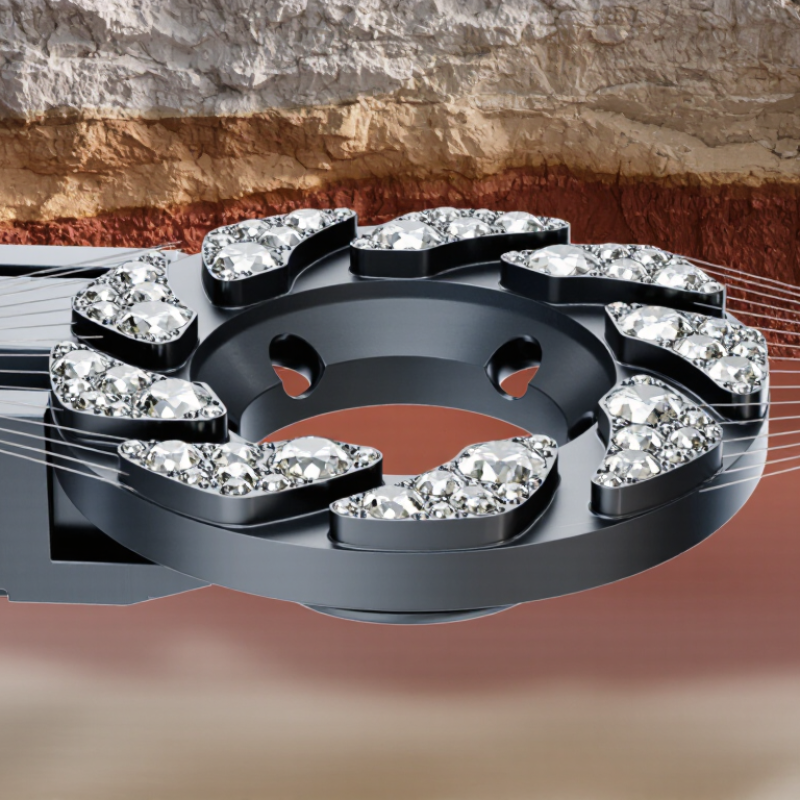
Non-planar PDC interface design changes how stress travels between the diamond table and carbide substrate. For 13.33–16 mm industrial cutters, the structured interface can improve load transfer, crack deflection, and thermal stability. The 2.67 mm size range also supports different cutter layouts, from dense blade coverage to stronger shoulder protection.
Practical benefits include better impact tolerance, reduced delamination risk, improved wear balance, and more predictable cutting efficiency.
SPE technical studies commonly associate three-dimensional interfaces with lower stress concentration than flat interfaces. Results vary with interface depth, diamond quality, and sintering control. Field engineers should avoid treating the geometry as a guaranteed upgrade.
The IADC dull-grading system measures cutter wear from 0 to 8, giving operators a consistent way to compare field results. A cutter showing less back-rake damage may still suffer thermal wear. That detail is easy to miss.
In testing, 13.33 mm cutters can offer tighter placement and more cutting points. Larger 16 mm cutters usually provide greater diamond volume and stronger impact resistance. However, larger cutters may increase torque and thermal load.
Non-planar interfaces can distribute these forces more evenly, but poor matching with the bit body may reduce the benefit. SPE laboratory reports also emphasize controlled temperature, pressure, and impact testing. Field data remains more persuasive than laboratory optimism.
It is a three-dimensional connection between the diamond layer and carbide substrate. The shaped interface changes how stress travels. It is not automatically better.
The design applies to cutters measuring about 13.33 to 16 millimeters. The smaller size supports tighter placement and more cutting points. The larger size contains more diamond volume.
It may increase the bonding area by roughly 20–40 percent. A broader contact zone spreads thermal and mechanical loads. Actual results depend on preparation and sintering quality.
It may lower interface stress and help deflect cracks. A stronger transition can resist separation during vibration and impact. Poor processing can cancel the benefit.
Field results suggest about 10–20 percent longer working life in suitable applications. Edges may chip less in mixed shale and limestone. This is a planning range, not a promise.
A 16-millimeter cutter usually offers greater diamond volume and impact resistance. However, it may increase torque and thermal load. Bigger is not always better.
Comparable field trials have reported torque reductions near 8–15 percent. Selected applications have shown penetration-rate gains around 12–25 percent. Formation strength and operating control strongly affect both results.
Compare bonding images, shear results, thermal cycles, wear grades, and failure locations. Test several samples from each production batch. One sample can mislead. Track temperature, vibration, weight, and rotary speed during field runs. Laboratory optimism sometimes fades underground.
Non-planar interface PDC cutters with 13.33–16 mm industrial cutter sizes are designed to improve the connection between the diamond table and carbide substrate. What are the benefits of non-planar interface PDC? The main advantages include a 20–40% larger bonding area, stronger resistance to interfacial shear, and improved structural integrity under demanding drilling conditions. The shaped interface can also enhance impact resistance and help maintain diamond-table stability at temperatures reaching approximately 750°C.
In practical operation, this design may extend cutter service life by 10–20%, reduce drilling torque, and support a faster rate of penetration. It is also suitable for applications requiring API 7-1 compatibility, stable supply capacity from China, and flexible field integration. Overall, the non-planar interface provides a balanced combination of durability, thermal stability, drilling efficiency, and operational adaptability for challenging rock-formation environments.

 Elliott Cutters